

Here at Bainbridge on Corporations we have frequently had occasion to address the hysteria concern in some quarters over the Citizens United decision that corporations have free speech rights. So you can imagine the consternation in some of those same quarters over the recent Delaware decision in American Civil Liberties Union of Delaware v. Town of Fenwick Island.1
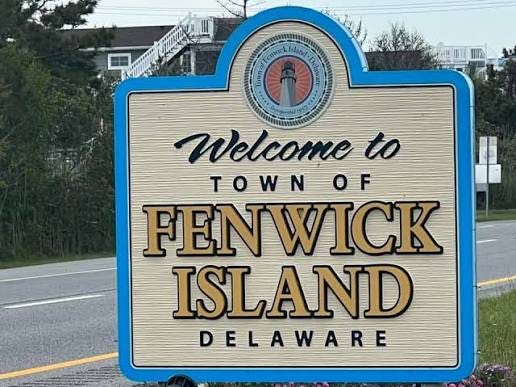
Fenwick Island is a coastal resort town in Sussex County, Delaware, United States. According to 2020 census figures, the population of the town is 355, a 2.6% decrease over the last decade.
Under Delaware law, except for the City of Wilmington, municipal voter eligibility “shall be as specified within the town charter; provided however, that in no event shall a municipality impose a durational residency requirement in excess of 30 days.” In 2008, the General Assembly amended Fenwick’s Charter to provide, in pertinent part:
(2) Non-residents: Every property owner as of March 1 prior to the annual municipal election, whether a natural person or artificial entity, including but not limited to corporations, partnerships, trusts, and limited liability companies, and who is registered to vote, if provided by ordinance, shall have one vote. A natural person shall be a citizen of the United States and age 18 on or before the date of the election. An artificial entity shall be a domestic entity in the State of Delaware.
(3) These provisions shall be construed in accordance with the principle of “one person/entity, one vote.” Where a voter is entitled to vote by virtue of being both a resident and as an owner of real property, that voter shall be entitled to only one vote; where a voter is entitled to vote by ownership of two or more parcels of real property, that voter shall be entitled to only one vote.
(4) Any legal entity other than a natural person entitled to vote, must cast its vote by a duly executed and notarized power of attorney from the legal entity granting the authority to cast its vote to its designated attorney-in-fact. ...
The ACLU sued, claiming that the charter thus violated the Elections Clause of the Delaware Constitution, which simply states: “All elections shall be free and equal.”
Judge Karsnitz of the Delaware Superior Court granted Fenwick Island’s motion to dismiss for failure to state a claim, finding that:
Visions of faceless large corporations or even HAL, controlling a small town are frightening and the stuff of science fiction. However, Plaintiff has not demonstrated that this policy violates the principle of one person/entity/one vote.
Predictably, this produced great consternation among the usual suspects on X.2
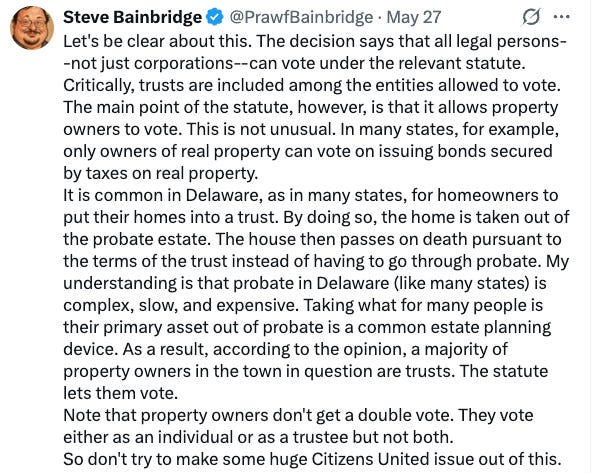
I pointed out that these concerns were overblown:
Proving once again that the Delaware legislature is not immune to X-spawned hysteria, however, some Delaware legislators have rushed to propose a constitutional amendment that would permit only natural persons to vote in any Delaware election.
So let’s think about this a bit.