

I have a short (~1500 word) post up at Columbia law school’s CLS Blue Sky blog, How the Business of Privateering Contributed to the Evolution of Corporate Law.
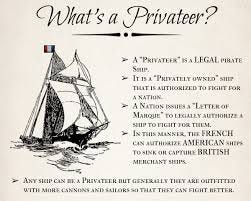
The post is based on my new law review article, Effecting Industrial Policy Via General Incorporation: Encouraging Privateering as Case Study, which is available from SSRN.
The SSRN abstract explains that: In Colonial America and the early United States, corporations were formed through special chartering. Each newly formed corporation required a separate act of the relevant state legislature. In the mid-1800s, however, states gradually shifted to a system of general incorporation pursuant to which a corporation could be formed without legislative action. The usual story offered by the legal literature to explain this switch sounds in efficiency and good government arguments. The special chartering process was time consuming, inefficient, generated logrolling, and encouraged corruption. Although the conventional origin story is correct, it is incomplete. General incorporation in fact was a method by which states effected industrial policy. This is the first article to explore that aspect of the shirt to general incorporation.
As a case study of the general argument, this article examines New York’s 1814 Act to Encourage Privateering Associations, the second general incorporation statute in U.S. history and a unique example of early industrial policy designed to facilitate private maritime warfare. The article situates the 1814 Act within the broader context of the War of 1812, examining the costs, risks, and organizational challenges that made both the privateering business and incorporation of that business attractive to potential investors. This early experiment in using incorporation to advance public policy objectives through private initiative offers valuable insights into both the historical development of American corporate law and the relationship between legal innovation and economic development in the early Republic.
Through detailed analysis of the Act’s provisions and historical context, this study advances three novel arguments. First, it demonstrates that early general incorporation statutes functioned as deliberate instruments of industrial policy rather than neutral procedural mechanisms, with the 1814 Act representing a novel state effort to harness private capital for national defense. Second, it provides insight into the contested evolution of essential corporate attributes by analyzing which features of the modern corporation the Act provided and which it omitted, contributing to ongoing scholarly debates about the truly indispensable characteristics of the corporate form. The statute’s design reveals contemporary understanding of how corporate privileges could encourage high-risk entrepreneurial ventures by providing limited liability, centralized management, and rudimentary asset partitioning. Third, it offers a case study of how economic necessity can drive the functional development of corporate features—particularly asset partitioning and limited liability—even when formal legal architecture remains incomplete.
Now I just need to find the article a law review home.