

One of the odd things about life on the internet (at least for those of us who grew up without one) is the way one forms friendships online with people one has never met in the flesh. I like to think I can include Lauren Pringle of The Chancery Daily among my circle of internet friends.
Ms. Pringle recently posted the following at LinkedIn:
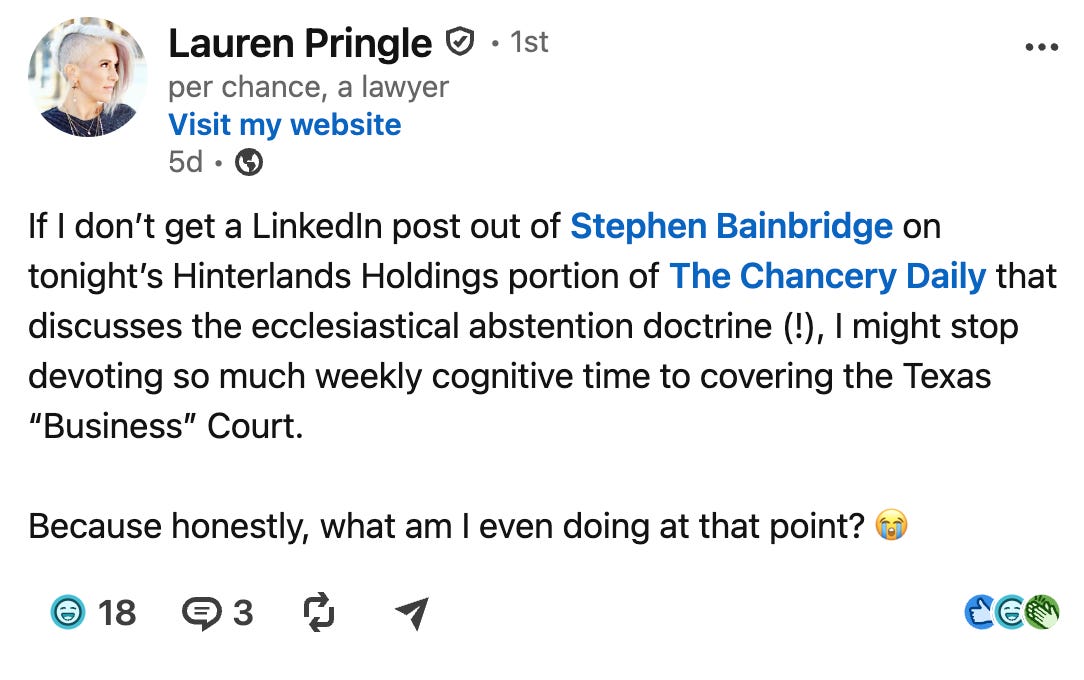

”Beloved”? My blushes.
And, yes, that is exactly my catnip. Corporate law as applied to religious entities has long been an intersection of my two main interests (sort of the flip side of my interest in theological implications for corporate law).
The Case: JCC v. Young
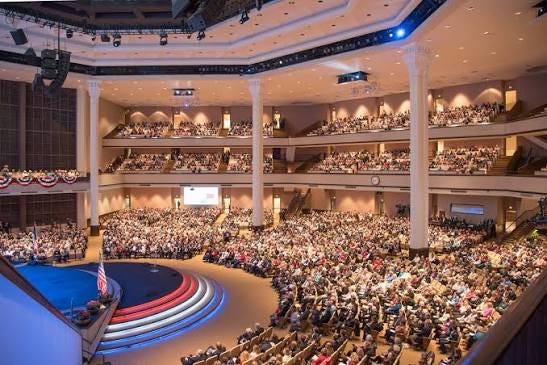
The case in question is Jeremiah Counsel Corporation v. Young.1 It arises out of a dispute at the Second Baptist Church of Houston (SBC), which is one of the largest churches in Texas. SBC is organized as a Texas nonprofit corporation, which means it is subject to the Texas Business Organizations Code. In turn, that places the legal regime in which the church operates within the framework of state corporate law, which became central to the dispute.
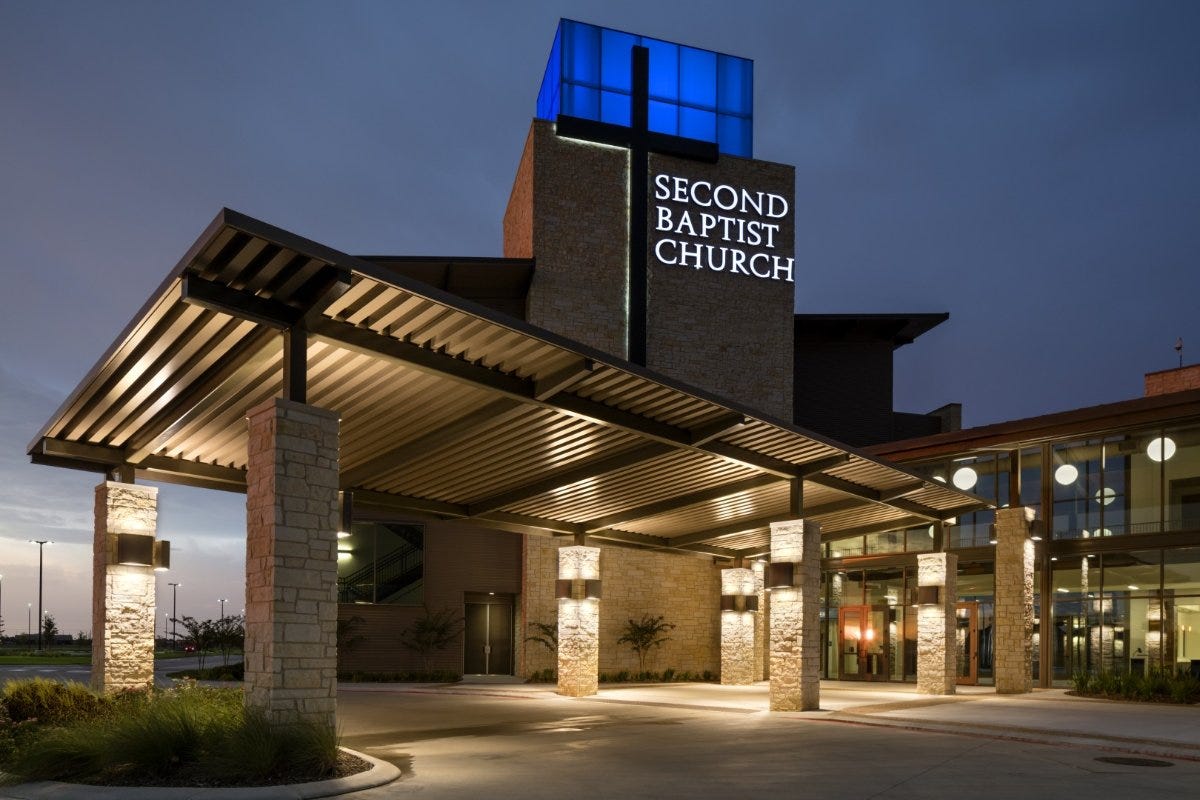
Is it just me, or does the church’s building look like an airport hotel?
For decades, SBC operated under articles of incorporation originally adopted in 1928 and later amended in 1978, along with its bylaws. Under that governance structure, church members had meaningful voting rights. Among other things, members participated in decisions involving church leadership and changes to the church’s governing documents.
That structure changed significantly in 2023.
In May of that year, church leadership proposed amendments to both the articles and the bylaws. The congregation considered the changes at a May 31 business meeting and approved them by a vote of 315–2.
The amendments did much more than make minor adjustments to the church’s governing documents. The new bylaws eliminated member voting rights and replaced the existing board structure with a self-perpetuating Ministry Leadership Team (“MLT”). They also gave Senior Pastor Ed Young substantial influence over the MLT’s membership and succession, while placing broad authority over church assets in the hands of the MLT.
Jeremiah Counsel Corporation (“JCC”), an association made up of current and former church members, challenged the changes in court. JCC alleged, among other things, that church leadership had used the restructuring to consolidate control and had not adequately disclosed the effect of the proposed amendments before the vote. It also asserted violations of Texas corporate law, breaches of fiduciary duty, ultra vires conduct, and claims involving the allegedly improper transfer of a church asset known as The Winning Walk.
FYI
The opinion explains that: “According to JCC, ‘The Winning Walk’ is a copyrighted multi-media platform that uses a website, books, videos, podcasts of sermons and church messages, and an on-line bookstore to share the Second Baptist ministry with people across the country. This program … was developed by Second Baptist's employees and officers using church resources, funds and facilities and constitutes the intellectual and physical property of the Second Baptist congregation.”
The Chancery Daily Takes Note
The Chancery Daily long has been my go to source for keeping up to date with developments in Delaware corporate law. Its daily email summary of decisions and filings is an essential resource.
With the rise of DExit and the concomitant growth in interest in Texas and Nevada corporate law, the perspicacious Ms. Pringle added a section that (with tongue firmly planted in cheek, I suspect) she calls Hinterlands Holdings, “highlighting nascent developments from business courts around the country.”
In August 18th’s Tuesday Texas Trailer report, she took note of four recent Texas Business Court decisions, including Young. She explained:
Plaintiff brought this action to challenge the 2023 Bylaws and the amendment to the Articles of Incorporation (together, the "2023 Amendments"). The TBC concluded as a threshold matter that it had the authority to determine the validity of the 2023 Amendments. The TBC concluded that, under the church autonomy doctrine, it lacked "neutral principles of law to be applied" and plaintiff's derivative-based claims of ultra viresacts, fraud, breach of fiduciary duty, civil conspiracy, tortious interference, and conversion were barred because defendants "acted in furtherance of the [c]hurch's religious mission and any judicial inquiry into the propriety of their choices would necessarily intrude upon the [c]hurch's right to structure its internal governance free from secular interference." The TBC also concluded that, while plaintiff lacked derivative standing, as an association of former and current members who lost their voting rights in the 2023 Bylaws, it possessed standing to bring direct claims. The TBC concluded that notices provided by the church made no mention of the Articles of Incorporation, invalidating this amendment, but that TBOC § 22.156(b) eliminated the written notice requirement (for churches) for meetings to amend bylaws. The TBC concluded that the 2023 Bylaws did not conflict with the Articles of Incorporation because the Articles did not specify who elected the trustees or expressly assign voting rights to members, leaving no basis on which to invalidate the bylaws.
Plaintiff also challenged the church's lawyer's conduct as legal counsel and later as a member of the Ministry Leadership Team. The TBC concluded that a challenge to conduct arising after joining the Ministry Leadership Team was barred by the church autonomy doctrine and plaintiff's lack of derivative standing. The TBC concluded that the court is expressly barred under Texas Government Code § 25A.004(h)(3) from exercising jurisdiction over claims rooted in alleged legal malpractice such as those arising from the lawyer's pre-appointment conduct.
The Big Question
The dispute ultimately raises a difficult question at the intersection of corporate law and religious autonomy: when a church chooses to organize itself as a corporation under state law, how far can a secular court go in enforcing the ordinary rules of corporate governance without crossing the line into the church’s right to govern its own religious affairs?
The Plan for Going Forward
I anticipate a total of four posts involving various aspects of this interesting case. In today’s post, I tee things up by discussing the various ways in which states have approached the question of incorporating churches and similar religious entities. In future posts, I will tackle the church autonomy issue, the corporate law issues bubbling under the surface, and finally some links to my prior work on incorporating religious entities.