

As we know, the SEC recently announced a proposed rulemaking that would give companies the option of shifting from quarterly to semi-annual reporting. As regular readers also know, I support the shift.
Letter of Comment to the SEC re Optional Semi-annual Reporting in Lieu of Quarterly Reports

I have submitted a letter of comment to the Securities and Exchange Commission regarding Proposed Amendments to Exchange Act Rules 13a-13 and 15d-13—Optional Semi-annual Reporting in Lieu of Quarterly Reports on Form 10-Q (File S7-2026-15):
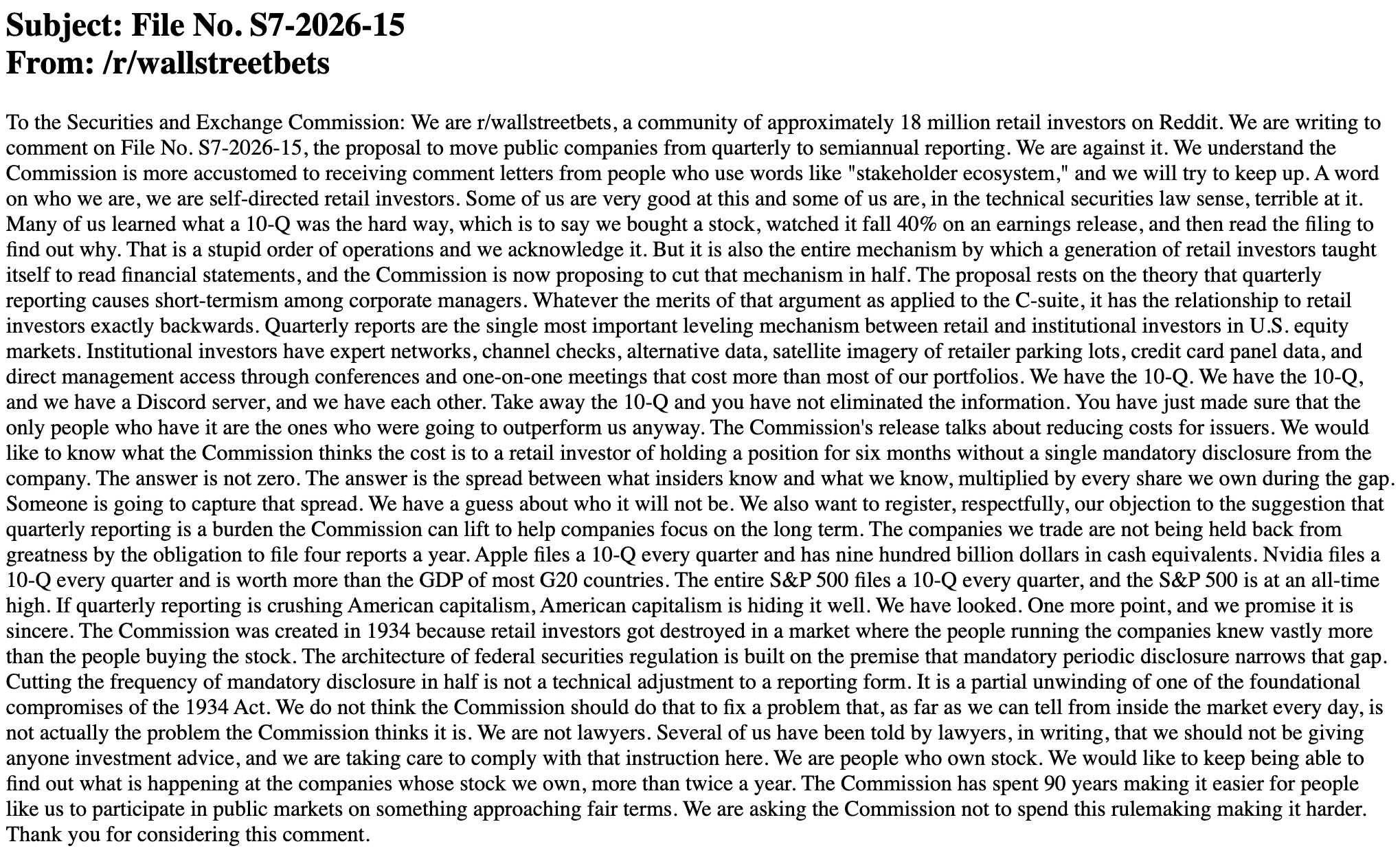
But not everybody does. One opposition comment that attracted a lot of attention purportedly came from /r/wallstreetbets, of which it has been said:
The subreddit, describing itself through the tagline "Like 4chan found a Bloomberg terminal",is known for its aggressive trading strategies, which primarily revolve around highly speculative, leveraged options trading. Members of the subreddit are often young retail traders and investors who ignore fundamental investment practices and risk management techniques, so their activities are often considered gambling.
Their argument about semi-annual reporting is that it will supposedly make their gambling more chancy:
There’s a lot of misinformation in that comment:
“Quarterly reports are the single most important leveling mechanism between retail and institutional investors in U.S. equity markets. Institutional investors have expert networks, channel checks, alternative data, satellite imagery of retailer parking lots, credit card panel data, and direct management access through conferences and one-on-one meetings that cost more than most of our portfolios. We have the 10-Q. We have the 10-Q, and we have a Discord server, and we have each other. Take away the 10-Q and you have not eliminated the information.”
B.S. US stock markets are highly efficient. By the time a retail investor gets their hands on a Form 10-Q the information in that report will already have been impounded into the company’s market price. Indeed, according to one study, the information in quarterly earnings announcements is fully impounded in the market price in about five second. The information in the 10-Q therefore has zero value to the retail investor. They cannot profit off it. So there is no levelling.
“The architecture of federal securities regulation is built on the premise that mandatory periodic disclosure narrows that gap.”
If the redditors had bothered to learn any history, they would have learned that the SEC did not begin mandating semi-annual reporting until 1955. Twenty one years after passage of the Securities Exchange Act of 1934. They also would have learned that the SEC did not require quarterly reporting until 1970. Yet, the market muddled along quite fine.
They also might have learned that the UK did not switch from semi-annual to quarterly reporting until 2007. They also might have learned that the UK switched back to semi-annual reporting just seven years later.
Beyond these basic factual errors, however, their comment raises a more fundamental question:
The Commission has spent 90 years making it easier for people like us to participate in public markets on something approaching fair terms. We are asking the Commission not to spend this rulemaking making it harder.
Should the SEC be in the business of facilitating retail investors? Or should SEC policy be designed to push retail investors towards passively managed index funds?