

SSRN Blues
Over at my other shop, StephenBainbridge.com, I’ve posted about the recent, significant, and unwelcome changes made by SSRN (the online “open access” scholarship) repository. Problem # 4 especially annoys me.
www.StephenBainbridge.com is an eclectic mix of ruminations about Catholicism (lots), politics (some), culture (a little), food and wine (a fair bit), and miscellany.

Bainbridge v. Shapira with Gatti as Referee
I was pleased to be invited by the eminent Matteo Gatti to participate in a cagematch fun and enlightening conversation with the perspicacious Roy Shapira. Matteo has kindly posted a summary of the podcast and links to it on LinkedIn. A brief taste:
The conversation opens with the foundational tension in corporate law — shareholder primacy as the standard of conduct versus the business judgment rule as the standard of review. Steve's point: boards are expected to maximize shareholder value, but courts almost never second-guess them if there's a rational business justification. The BJR does most of the heavy lifting in practice. Steve also walks through constituency statutes — the ones that let boards consider employees, communities, and other stakeholders. Fewer than 40 cases ever decided under them, none clearly changing the shareholder primacy norm. Bottom line: courts won't review the decision regardless of jurisdiction.
…
Roy brings in Caremark: when does a failed ESG bet become a real oversight liability problem? His answer: it depends on whether the issue is mission critical to that particular business. And his one-word advice to boards navigating all of this: document.

Much Hubbub About Little
Bloomberg recently (somewhat breathlessly) reported that:
A first-of-its-kind court decision affirming that some Delaware businesses can participate in municipal elections is stoking alarm and confusion about the explosion of corporate political clout at a precarious moment for voting rights nationwide, Mike Leonard reports.
Dozens of municipalities allow some version of entity voting, but the court opinion — tying the practice expressly to notions of corporate personhood and Delaware’s role in the corporate ecosystem — is shining an awkward spotlight on policies that have flown under the radar for decades.
Delaware Superior Court Judge Craig A. Karsnitz appears to be the first public official to “clearly articulate the ideological connection between Delaware’s ‘corporate franchise’ and its enfranchised corporations,” said University of Delaware historian Dael Norwood. “That connection has been indirect — at least until Judge Karsnitz wrote an opinion that said the quiet part out loud.”
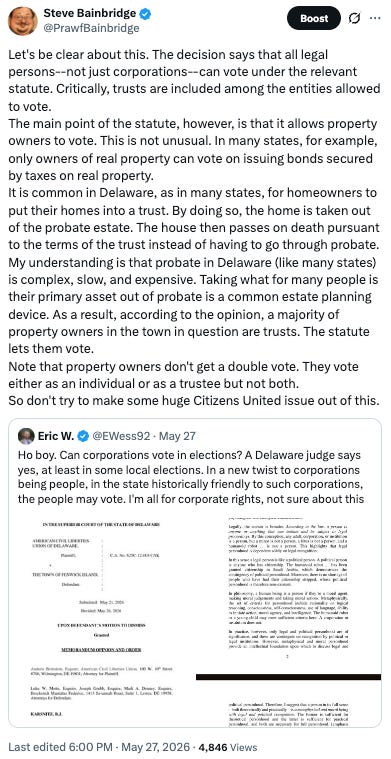
The ruling upheld a provision authorizing voting by in-state corporations, LLCs, trusts, and partnerships owning property within the tiny town of Fenwick Island, population 401. Karsnitz acknowledged that entity voting may conjure dystopian science fiction “visions of faceless large corporations or even HAL controlling a small town.” But it’s permissible under the principle of “one person/entity, one vote,” he said.
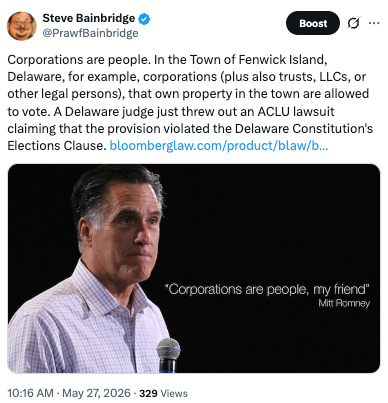
Predictably, this also generated some Citizens United-linked consternation on X:
Should I do a whole post about this one?