

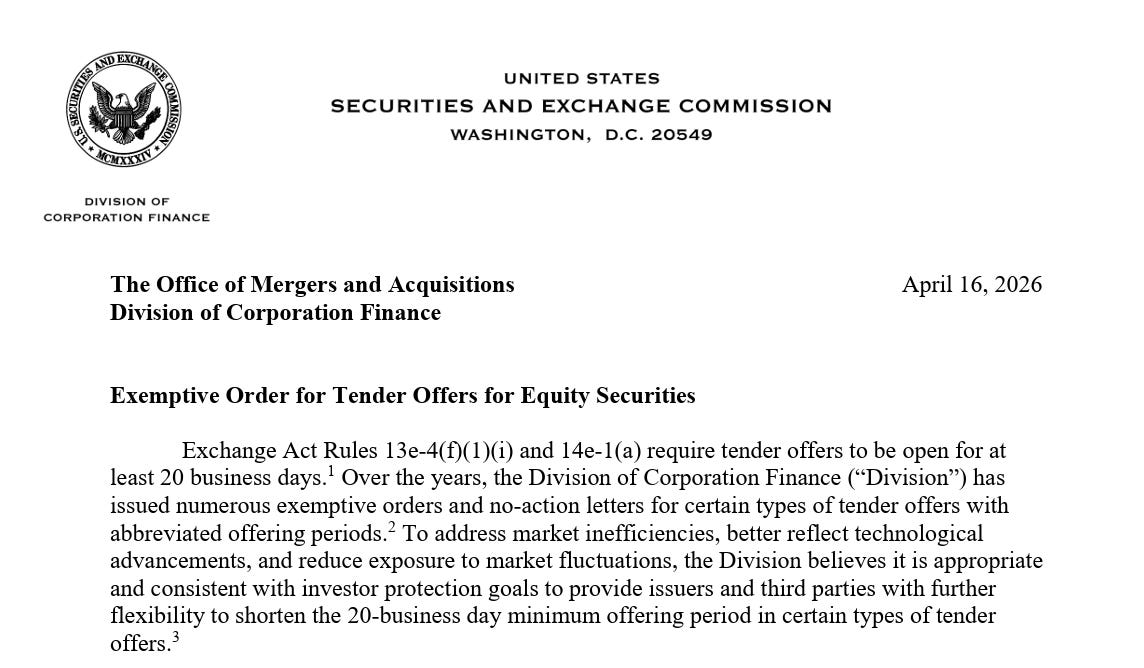
Last week, the SEC’s Division of Corporate Finance announced an “Exemptive Order for Tender Offers for Equity Securities”:
The Division, acting for the Commission pursuant to delegated authority, hereby grants exemptions from Exchange Act Rules 13e-4(f)(1) and 14e-1(a) and (b) to permit a tender offer for any class of equity security to remain open for a minimum offering period of 10 business days, so long as the following conditions are met ….
The order goes on to list 11 conditions that must be met.
Since this post is mainly pulling together commentary by others, I’m not putting it behind the paywall.
Coates’ Question
This development prompted Harvard law professor John Coates to opine at LinkedIn:
- APA prior notice? None.
- Opportunity for public comment? None.
- Studies conducted? None.
- Investor views considered? None stated.
- Precedents cited? Debt tender offers and one Trump-era no-action letter where Indian law and US law conflicted.
Is dramatically changing the first and most important formally promulgated tender offer rule an "interpretative" rule exempt from the APA [i.e., the Administrative Procedure Act]?
Great question, as I noted in reposting his comment:
The memo uses the phrase "pursuant to delegated authority" three times in four pages (the last of which is barely a quarter-of-a-page), but never specifies the authorization in question. …
In the comments, Jeffrey Gordon opines that:
”Using ‘exemptive relief’ to effectuate the most significant change to the TO rules in a generation -- one that in interaction with applicable Delaware statutory and fiduciary law could bring back the Saturday Night special -- is textbook "arbitrary and capricious."
I'd encourage him to spell out the relevant statutory and fiduciary law and how it would bring back the Saturday Night Special?
FYI: A "Saturday Night Special" is an outdated term for a surprise, rapid hostile tender offer aimed at taking over a company before it can mount a defense. These offers were traditionally launched over a weekend to catch target management off guard. The Williams Act effectively banned them. And the new order does set a 10 day tender offer period.
Gordon’s Blog Post
Professor Gordon elaborated on his comment today in a CLS Blue Sky Blog post. You really should go read the whole thing, but here’s a summary.
Gordon refers to the Division’s order as the biggest revision to the Tender Offer Rules in a generation. Most importantly he writes that it was done without an APA Notice & Comment process, no cost-benefit analysis, and no investor survey. As such, he contends that the SEC has acted arbitrarily and capriciously.
Gordon’s primary concern is that there are likely serious conflicts between the SEC’s Exemptive Order and § 251(h) of the Delaware General Corporation Law (“DGCL”)— the “Medium Form” merger statute. That section provides that a friendly acquiring corporation may avoid obtaining approval of a merger from the shareholders of the acquired corporation if the acquiring corporation obtains control over 50% of the acquired corporation’s voting stock in a tender offer and completes the merger after receiving those shares. Accordingly, Gordon argues, an all cash friendly acquisition can now be completed in approximately 12 calendar days rather than the current ~26.
As all students of Delaware corporate law know, Revlon requires the board of directors of a publicly traded corporation to seek maximum value for its shareholders when selling the company. But, having entered into a friendly deal, the target corporation’s board need not pause solely to allow another bidder to make an offer. In addition, under Corwin and Volcano, if a majority of shareholders approve a tender offer of sufficient size and with adequate disclosure regarding the expedited timeline—i.e., that it may preclude any additional bids—then that approval will release the directors from their fiduciary duties to consider alternative offers and they will have no duty to seek alternative offers. As such, boards of directors have essentially no fiduciary responsibility to reject a lower priced acquisition in favor of a higher price acquisition, so long as the lower price is approved by a majority of shareholders.1
Gordon also argues that the shorter offer period may encourage hostile offers and, because the shorter duration decreases the likelihood that competing bidders will emerge, Gordon expects a large number of these acquisitions to be consummated at depressed prices.
Finally, Gordon notes that the SEC’s Exemptive Order is defective on its face for two distinct reasons. (1) It is an important rulemaking effort masquerading as an exemptive order so as to circumvent the APA’s rulemaking requirements. (2) Under 17 CFR § 200.30-1(f)(16)(ii) (the SEC’s standing delegation rules), Corporate Finance may only grant requests for exemptions filed by parties seeking relief in specific cases, whereas here Corporate Finance issued an advance ruling granting a broad category of exemptions that had been requested by no one.
Bishop’s Response
Our friend and frequent interlocutor Keith Bishop responded to Coates’ question on his must-read California Corporate Law Substack.

As for the APA question, Bishop points out that:
The Administrative Procedure Act (”APA”) distinguishes between “legislative rules” and “interpretive rules”. One of the four key differences between “legislative rules” and “interpretive rules” is that federal agencies must, subject to certain exemptions, adopt “legislative rules” in accordance with the APA’s requirements of notice and comment. The APA specifically exempts interpretive rules from the APA’s notice and comment requirements. 5 U.S.C. § 553(b).
The rub, of course, is how do you tell the difference between these two types of rules? This is a question that is frequently litigated, including by the Commission.
Presumably Bishop contemplates an argument that this is an interpretative rule rather than a legislative rule.
In addition, however, Bishop also observes that:
A footnote to the exemptive order states:
“The Commission has authority under Exchange Act Sections 14(d)(5), 14(d)(8)(C) and 36(a) to provide exemptions from the tender offer provisions of Exchange Act Sections 13(e) and 14(d)(1) through 14(d)(7), Exchange Act Rule 13e-4, Regulation 14D, and Rule 14e-1 of Regulation 14E. The Commission has delegated this exemptive authority to the Division. See 17 CFR 200.30-1(f)(16).”
Each of Sections 14(d)(5), 14(d)(8)(C), and 36(a) refers the Commission acting by rule, regulation, or order. Thus, each of these statutes plainly contemplates “orders” as a category distinct from rules and regulations.
I take it that Bishop thus believes that the Corporate Finance Division may well have had delegated authority to issue the order in question. Unless, of course, “order” contemplates a response to a specific request for relief rather than a broad exemption.2
Finally, Bishop tackles the merits:
Importantly, times have changed dramatically since 1979 when the Commission imposed a 20 business day minimum. Then, both the Internet and EDGAR were still years in the future. In Bucher v. Shumway, 452 F. Supp. 1288 (S.D. N.Y. 1978), the court stated that the sole purpose of the Williams Act is to “provide information to the investor so that he may make a rational decision whether or not to tender all or part of his shares”. 452 F. Supp. at 1294 (citing H.R. Rep. No. 1711, 90th Cong., 2d Sess.). Information is disseminated to the market far more quickly than it was nearly a half century ago. By expressly authorizing the Commission to proceed by order, Congress presumably intended to authorize the Commission to act with greater celerity in response to changing conditions than rule making allows.
My Take
Let’s split the baby in two. First, is there a serious APA issue here? I’m not an administrative law expert. I’m barely an administrative law novice. I found Gordon’s post to be cogent and well thought out. But I think Bishop raises some very valid points. Accordingly, although I lean in Gordon’s direction, on this issue, I shall courageously duck the question.
Second, is the order unwise? I can see Gordon’s points and freely concede that his scenario could pan out occasionally. I think he spotted a serious problem. But I also thought Bishop’s point has merit. Information does move faster than ever and this has been reflected in many SEC rules (e.g., the shortened time periods for filing Schedule 13Ds and amendments thereto). So, on this one, I think I lean slightly towards Bishop’s side, but once again shall courageously equivocate.
Joel Friedlander offered the following comment to Gordon’s CLS post:
But see In re Mindbody Inc. Stockholder Litigation (Del. 2024) (affirming damages award against target CEO for breach of fiduciary duty under Revlon “who tilted the sale process toward [buyer] for personal reasons and was not adequately overseen by the Board” and “kept material information from the Board”; “Corwin cleansing was not available”).
Gordon noted that the order “seems to have been announced without deliberation by the Commission itself.” Bishop did not address that point in his Substack, but kindly authorized me to quote from an email exchange between the two of us in which he observed that:
I assume that as a practical matter the staff proceeded with the tacit consent of at least a majority of the Commission and the Commission could “own” the order directly if it chooses to do so. I also think that the stronger argument as to the application of the APA is that this is an order, not a rule (whether legislative or interpretive) and Congress has expressly authorized the Commission to take action by rule or order.