

As we have discussed many times here at Bainbridge On Corporations, Securities and Exchange Commission Chairman Paul Atkins has been signalling an interest in modifying and/or rescinding the shareholder proposal rule (Securities Exchange Act Rule 14a-8). The time has finally come.
Flash News: SEC Proposes Repeal of the Shareholder Proposal Rule

The SEC has proposed rescinding the shareholder proposal rule (Securities Exchange Act Rule 14a-8).
In 1942, when one might have thought the government had bigger fish to fry, the SEC adopted what was then called Rule X-14A-7. Later renumbered Rule 14a-8 and amended extensively, the so-called shareholder proposal rule has become a fixture of American corporate governance.

In brief, the rule allows shareholders of public corporations who meet certain eligibility requirements to have a proposal—along with a supporting statement, the two together capped at 500 words—included in the company’s annual meeting proxy statement and proxy card so that shareholders may vote on the proposal. If the Rule did not exist, a shareholder wishing to have a matter put before the annual shareholder meeting would be obliged to go to the expense and hassle of conducting a proxy solicitation with its own proxy statement and card. Given that the median cost of a proxy solicitation in 2017-2020 was $750,000 and that the costs incurred by the proponent of shareholder proposal rarely exceed $20,000, the cost advantages are obvious.
Assuming that the proponent meets the rule’s ownership thresholds and comply with the rule’s various procedural requirements, the company must include the proposal unless it can establish that the proposal falls within one of the rule’s thirteen substantive exclusions, such as improper subject under state law, ordinary business, relevance, substantial implementation, duplication, or resubmission.
Every proxy season, hundreds of proposals—on topics ranging from declassified boards to climate disclosure—make their way onto corporate proxy statements via Securities Exchange Act Rule 14a-8. Generations of corporate lawyers have cut their teeth on no-action letters parsing the rule’s thirteen substantive exclusions.
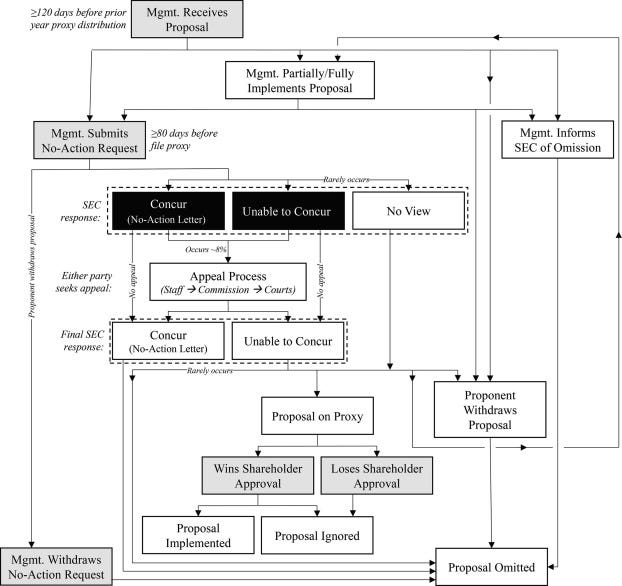
Gregory Burke, SEC Rule 14a-8 shareholder proposals: No-action requests, determinants, and the role of SEC staff. Journal of Accounting and Public Policy, Volume 42, Issue 1.
The Proposing Release
In Rescission of Rule 14a-8’s Federal Regulation of Shareholder Proposals and Amendments to Rule 14a-4, Release No. 34-106383 (File No. S7-2026-32), the Commission proposes to rescind Rule 14a-8 in its entirety and “leave determinations about the role of shareholder proposals to State law and company governing documents” (Release at 1). At the same time, it proposes to amend Rule 14a-4, which governs discretionary voting authority, to expand the circumstances in which a company may vote proxies it receives on shareholder proposals that are not included in the company’s own proxy materials.
In this post, I want to lay out what the Commission has proposed and the reasons it gives. I will save my views on the merits for another day (actually, a lot of future days, given how much there is to say).
Of course, regular readers can doubtless guess where I will come out. I have not exactly been playing hide the ball, after all.