

As I discussed in Part I of this series, Texas does not have a separate corporations statute under which churches and similar religious entities may incorporate. Instead, Texas churches must incorporate under the state’s nonprofit corporation statute, which offers only a few targeted accommodations for religious organizations.
Jeremiah Counsel v. Young (Tex. Bus. Ct. July 15, 2026) and The Law of Religious Corporations: Part I

One of the odd things about life on the internet (at least for those of us who grew up without one) is the way one forms friendships online with people one has never met in the flesh. I like to think I can include Lauren Pringle of The Chancery Daily
That structural choice drives the central question in Young1; namely, once a church incorporates under secular corporate law, how far can a secular court go in enforcing that law before it crosses into territory the First Amendment puts off-limits?
The Facts
You will recall from Part I that the Second Baptist Church of Houston is a mega-church with a whopping 94,000 parishioners.
FYI
According to Wikipedia (FWIW), the church started with 121 members in 1927. Its current membership represents a 777-fold increase, representing a 6.54% annual compounding rate of increase. Its main site seats 5,500, with five additional sites scattered throughout the Houston area. “In addition to worship facilities it ‘has fitness centers, bookstores, information desks, a café, a K-12 school and free automotive repair service for single mothers.’”
The church long operated as a Texas nonprofit using articles of incorporation drafted in 1978 and a set of bylaws adopted in 2005. The articles and bylaws gave the congregation substantial voting rights, including the right to elect the Senior Pastor and Board members and to approve any amendments to the governing documents.
In May 2023, church leadership proposed sweeping amendments to both documents. Notice went out on four separate occasions—twice via the weekly church newsletter, on May 19 and 26, and by oral announcement at all six church campuses during weekend services on May 21 and 28—stating the purpose was “to update our by-laws, to protect our ability to continue operating as a Biblical Church.” At a May 31 meeting, the congregation voted 315–2 to approve. The new bylaws eliminated member voting rights entirely, replaced the elected Board with a self-perpetuating “Ministry Leadership Team” (MLT) controlled by the Senior Pastor, and vested the MLT with broad discretion over church assets.
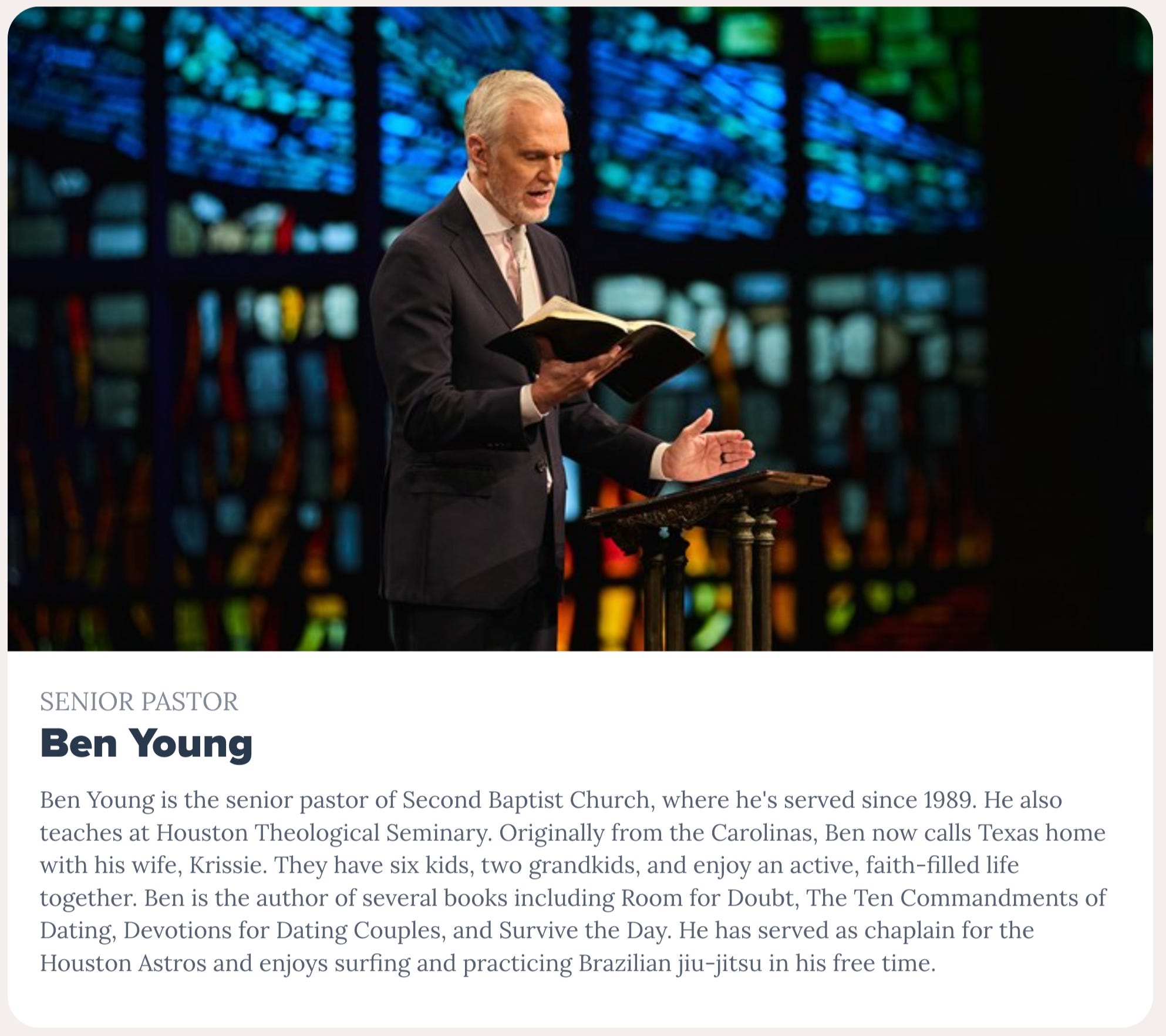
Then-Senior Pastor Ed Young subsequently appointed his son Ben Young as the church’s new Senior Pastor. Ben stacked the MLT with his friends and family members. The MLT then transferred a media platform called The Winning Walk to Ed Young.
A group of current and former members, organized as Jeremiah Counsel Corporation (”JCC”), sued in the Texas Business Court, seeking to void the amendments and pursuing derivative claims for breach of fiduciary duty, ultra vires acts, fraud, conversion, and more.
The Current Decision
In resolving cross-motions for summary judgment, the trial judge opined that:
Before reaching the merits of the motions, however, the Court must clear two jurisdictional hurdles. The first is the boundary between a church’s constitutional right to self-governance and its statutory obligations as a Texas nonprofit corporation. Relying on the First Amendment, Defendants argue that the church autonomy doctrine bars all but one of the Plaintiff’s claims because this lawsuit concerns matters of faith and internal church governance.
The Second Hurdle
The other preliminary issue was a standing question. The court held that JCC had standing to pursue the direct claims, including those seeking a declaratory judgment that the amendments to the articles were invalid. It concluded that JCC lacked standing to pursue the derivative claims, including the breach of fiduciary duty claims against the individual defendants.
An outfit called Trinity Foundation, which has been critical of former Senior Pastor Ed Young in the past, reports that JCC is pressing new motions to determine the validity of the MLT structure.