

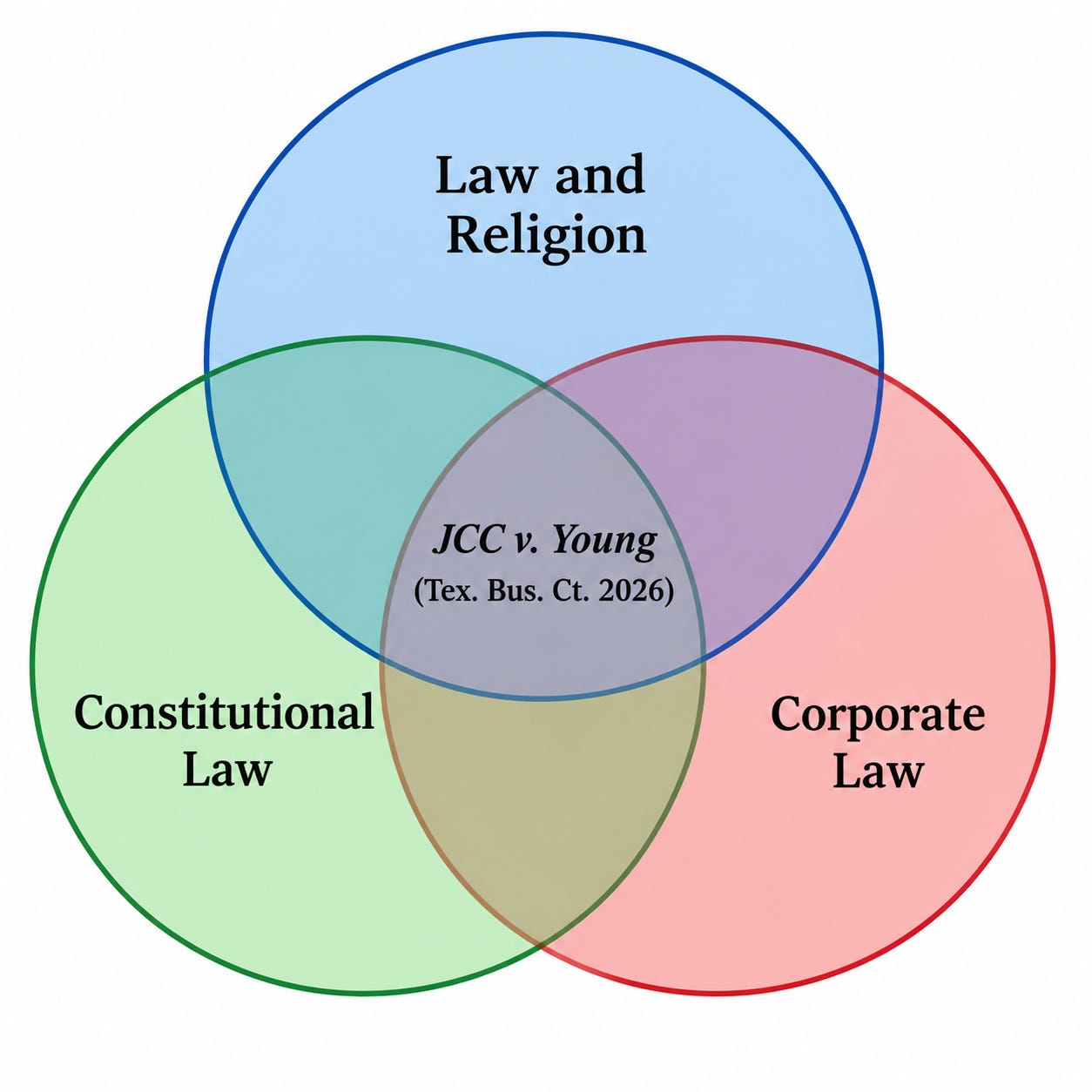
In three prior posts, I discussed a recent Texas Business Court (TBC) decision, Jeremiah Counsel Corp. v. Young,1 which raised a number of interesting issues about the relationships between religious entities, constitutional religious liberty, and corporate law.
Part I discussed state approaches to incorporating churches and other religious entities:
Jeremiah Counsel v. Young (Tex. Bus. Ct. July 15, 2026) and The Law of Religious Corporations: Part I

One of the odd things about life on the internet (at least for those of us who grew up without one) is the way one forms friendships online with people one has never met in the flesh. I like to think I can include Lauren Pringle of The Chancery Daily
Part II discussed the role played in the case by the constitutional law church autonomy doctrine:
Jeremiah Counsel v. Young (Tex. Bus. Ct. July 15, 2026) and The Law of Religious Corporations: Part II

As I discussed in Part I of this series, Texas does not have a separate corporations statute under which churches and similar religious entities may incorporate. Instead, Texas churches must incorporate under the state’s nonprofit corporation statute, which offers only a few targeted accommodations for religious organizations.
Part III tackled the corporate law issues, focusing on the contractual nature of corporate organic documents:
Jeremiah Counsel v. Young (Tex. Bus. Ct. July 15, 2026) and The Law of Religious Corporations: Part III

This is the third in a series of articles inspired by a recent Texas Business Court (TBC) decision, Jeremiah Counsel Corp. v. Young, which raised a number of interesting issues about how religious entities, constitutional religious liberty, and corporate law combine.
Addenda: “Elected” But by Whom?
Since writing Part III, I came across an article by an entity called the Trinity Foundation in which they assert that:
Almost buried in Texas Business Court Judge Grant Dorfman’s ruling against Jeremiah Counsel Corporation (JCC) last month certifying Second Baptist’s suspicious 2023 bylaws revision was a clause returning the church to its 1928 charter and rejecting Second Baptist’s 2023 charter amendment. …
… a new filing by Jeremiah Counsel argues the Judge’s rejection of the 2023 charter amendment legitimizes the original 1928 charter, is prima facia evidence invalidating the current board made up of mostly Young family members (dubbed the “Young Group”) and automatically reinstates the board of trustees extant prior to the 2023 amendment.
The new filing states in pertinent part that:
Article V of the 1928 Articles (“Article V”) provides: “This Corporation shall have Six (6) Trustees, who may be elected annually, or in classes with terms of office not exceeding three (3) years, as this Corporation may, from time to time, deem desirable.” [My emphasis]
The crucial difference between still-governing Article V and Defendant’s failed amendment is that the former only allows Board members to be elected, while the latter would permit members of Second Baptist’s Board or MLT members to be elected, appointed or designated. As addressed more fully below, Defendants argued that Board members may be elected by other Board members. JCC disagrees, and argues that under the governing documents, Board members may only be elected by church members. However, all parties agree that the Articles require Board members to be elected.
As I explained in Part III, Article V says “elected” but does not specify by whom. JCC now argues that the new MLT (effectively the church’s board of directors) was not elected but rather selected:
As the Court itself found, under section 5.01, the initial MLT was to be composed (1) of the Senior Pastor, who was simply designated under the 2023 Amended Bylaws to take a seat on the MLT when these Bylaws were adopted, and (2) individuals whom the Senior Pastor then appointed to the MLT.
Hence, the JCC prays for relief (among other requests):
Rule that the term “elected” as used in the church’s Articles of Incorporation is ambiguous and that its meaning should be submitted to the fact finder or clarify for the record that the Court determined JCC’s reading of “elected” is unreasonable.
It’s an interesting and, it seems to me, plausible argument. So we will continue following this case.

My Law and Religion Scholarship
Over at StephenBainbridge.com, my eclectic personal online journal, I posted an essay on being a Christian and a lawyer with emphasis on bringing the values of my Catholic faith to bear on my vocation as a legal scholar:

In a subsequent post, I offered brief descriptions of and links to my own work in law and religion. My work in the field generally falls into two categories. One is akin to the posts here about the Young case; namely, the corporate law and governance applicable to religious organizations. Hence, for example, articles about piercing the corporate veil in the case of corporations sole. The other is more jurisprudential, focusing on how Christian teaching (especially Catholic social thought) can help us understand but also critique secular legal doctrines.
I encourage you to check them out.
No. 25-BC11B-0031, 2026 Tex. Bus. 46, 2026 WL 2076098 (Tex. Bus. Ct. July 15, 2026).